In 1970, John Archibald Wheeler drew a map of everything physics didn’t understand. Half a century later, a physicist in Tsukuba, Japan may have found the territory it pointed to — inside the human brain.
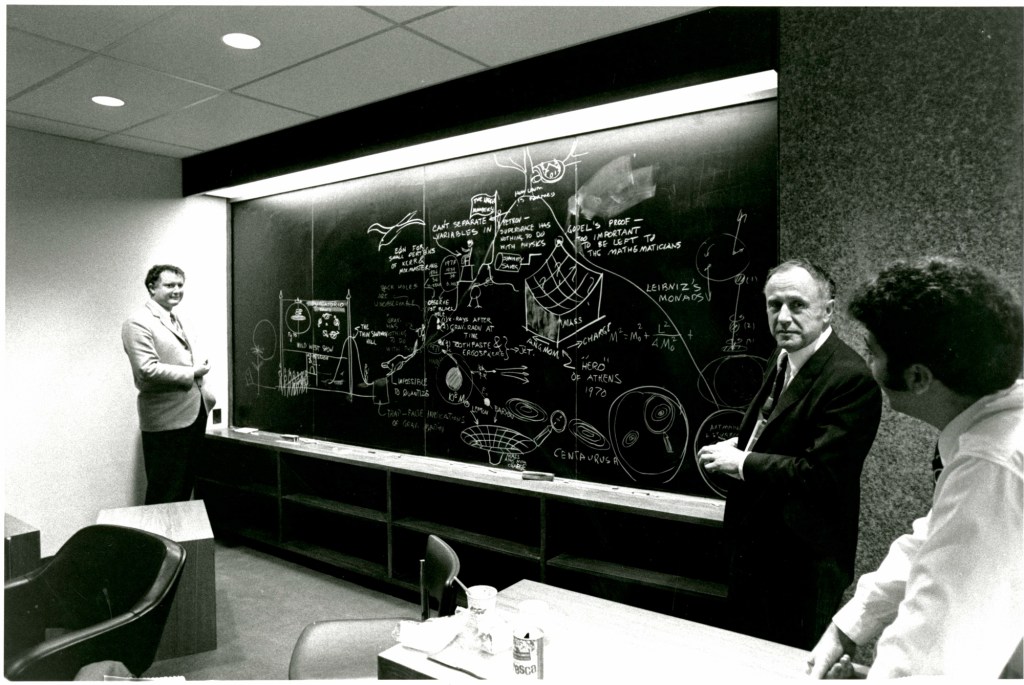
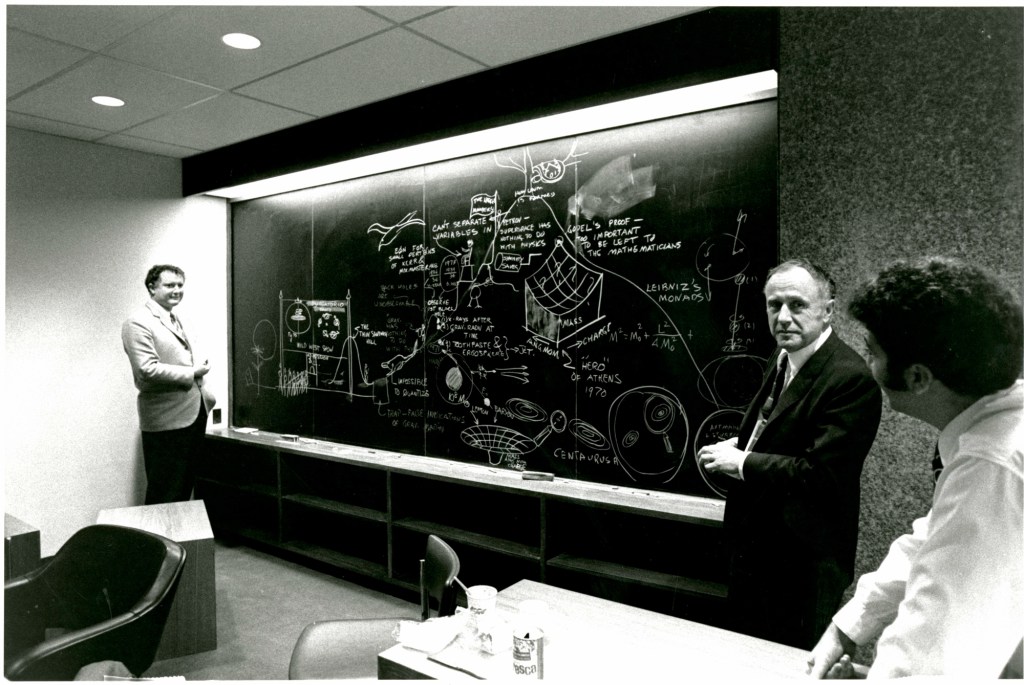
John Archibald Wheeler before his blackboard, University of Texas at Austin, c. 1970. The board maps the deepest unresolved problems at the boundary of general relativity, quantum mechanics, and the nature of reality — a crisis Wheeler spent his life trying to resolve.
John Archibald Wheeler — the man who coined the terms “black hole” and “wormhole,” who mentored Richard Feynman and helped build the hydrogen bomb, who spent decades as the most imaginative physicist alive — stands before a blackboard at the University of Texas at Austin.
This board is covered not with a tidy proof but with a sprawling, hand-drawn map of everything he didn’t know how to solve.
It is a map of the crisis in physics. And reading it carefully, you find something unexpected: it is also, in embryonic form, a map of consciousness.
Reading the Board
The blackboard is not a lecture. It is a topology of open problems — a mind wrestling with the deepest unresolved questions at the intersection of general relativity, quantum mechanics, and the nature of reality. The entries cluster around several themes, all of which Wheeler believed were facets of a single mystery.
Black Holes and the Erasure of Identity
Dominating the left and center of the board are references to black holes. Wheeler had coined the term three years earlier, in 1967, and by 1970 he was mapping their full implications. The board shows the ergosphere — the region outside a rotating black hole’s event horizon where spacetime itself is dragged into co-rotation — and what Wheeler called the “toothpaste tube” analogy, his way of visualizing matter being squeezed through gravitational collapse until it crosses a point of no return.
Nearby, the cluster around “MASS,” “ANG. MOM.” (angular momentum), and “CHARGE” — with the equation M = M₀ + … — is Wheeler articulating what would become the no-hair theorem: a black hole is completely characterized by only three externally observable quantities. Everything else — every detail of the star that collapsed, every bit of its history — is destroyed. The phrase “black holes have no hair,” which Wheeler popularized, is a statement about the total annihilation of information. This was a conceptual earthquake. It set up what would become the black hole information paradox — the deepest tension in theoretical physics — which remains unresolved today.
Superspace and the Quantum Universe
In the upper-center, a blunt confession: “CAN’T SEPARATE VARIABLES IN SUPERSPACE.”
“Superspace” was Wheeler’s term for the infinite-dimensional space of all possible 3-geometries — every possible shape a spatial slice of the universe could take at a given moment. With Bryce DeWitt, he had attempted to write a quantum wave equation for the entire universe — the Wheeler-DeWitt equation — treating the shape of space itself as the quantum variable. But he was hitting a wall. The equation couldn’t be solved the way a hydrogen atom can be solved, because the variables couldn’t be separated. The mathematical structure of the space of all possible universes was too entangled with itself.
Even more striking is the note beside it: “SUPERSPACE HAS NOTHING TO DO WITH PHYSICS.” This is Wheeler in self-interrogation mode, questioning whether his own formalism pointed to reality or was merely a beautiful abstraction leading nowhere. Few physicists have been so willing to publicly doubt the foundations of their own program.
The Spacetime Foam
The sketches Wheeler labeled “THE UGLY AMOEBAS” refer to his spacetime foam hypothesis. At the Planck scale — roughly 10⁻³⁵ meters — Wheeler proposed that spacetime is not the smooth, continuous manifold of Einstein’s equations but a seething quantum foam of fluctuating topology. Wormholes, handles, and bubbles appear and dissolve on timescales of 10⁻⁴³ seconds. The “amoebas” are his visual metaphor for this: shapeless, multiply-connected topological blobs replacing the clean geometry of classical spacetime.
This was Wheeler’s deepest intuition about quantum gravity, and it remains influential. It implies that at the most fundamental level, geometry itself is a quantum variable — not a stage on which physics happens, but an actor in the drama.
Gödel, Leibniz, and the Self-Referential Universe
The right side of the board takes a sharp philosophical turn. “GÖDEL’S PROOF — TOO IMPORTANT TO BE LEFT TO THE MATHEMATICIANS” is vintage Wheeler provocation. Gödel’s incompleteness theorems show that any sufficiently powerful formal system contains true statements it cannot prove from within. Wheeler believed this wasn’t just a mathematical curiosity — it was a clue about the structure of physical reality. A universe that observes itself into existence, as Wheeler suspected ours does, would necessarily be self-referential in the Gödelian sense: it would contain truths about itself that no internal observer could fully capture.
Below this, “LEIBNIZ’S MONADS.” Wheeler was reaching back three centuries to Leibniz’s metaphysics — the idea that reality is composed of fundamental, indivisible units of perception called monads, each reflecting the whole from its own perspective. Wheeler saw a structural resonance between monads and quantum events: elementary acts of observation that collectively constitute reality, each one a partial view of the whole.
These are not idle philosophical musings on a physicist’s blackboard. They are signposts toward Wheeler’s ultimate conclusion, which he would spend the next two decades developing: “it from bit.” Every physical quantity derives its meaning from information — from binary yes-or-no answers extracted by observation. The universe is not made of matter. It is made of meaning.
The Astrophysical Anchors
Wheeler never let his speculations drift free of observation. “CENTAURUS A” at the bottom of the board is one of the most powerful radio galaxies in the sky, driven by a supermassive black hole with relativistic jets. It connects his theoretical work on gravitational collapse to real astrophysical objects. References to “X-rays after grav. radi at time” concern the observational signatures of gravitational radiation and collapse events — the predictions that would, decades later, be confirmed by LIGO’s detection of gravitational waves.
“TRAP — FALSE IMPLICATIONS OF GRAV. WARN[ING]” shows Wheeler cautioning himself and his students against misreading gravitational wave predictions — distinguishing real physical signals from artifacts of coordinate choices. Even at his most visionary, Wheeler insisted on empirical discipline.
Geometrodynamics: The Program
Behind the blackboard’s scatter of ideas lies a single, unifying program that consumed Wheeler for decades. He called it geometrodynamics, and its premise was audacious in its simplicity: everything is geometry.
The starting point is general relativity, which shows that gravity is not a force but the curvature of spacetime. Wheeler pushed this to its logical extreme. What if all of physics — not just gravity, but electromagnetism, charge, mass, particles — is nothing but the dynamics of spacetime geometry itself? What if there is no “stuff” inhabiting spacetime, and the geometry is the substance?
In this framework, an electron is not a thing in spacetime — it is a particular geometric structure of spacetime. Electric charge is not a property of a particle but lines of electric flux trapped in a wormhole-like topological handle. Wheeler called this “charge without charge” — the appearance of charged matter from pure geometry. He developed the concept of geons (gravitational-electromagnetic entities): self-consistent bundles of electromagnetic or gravitational energy held together by their own curvature. Matter, in this view, is what geometry looks like when it gets complicated enough.
To make this precise, Wheeler (with Richard Arnowitt, Stanley Deser, and Charles Misner) developed the ADM formalism, which splits four-dimensional spacetime into a sequence of three-dimensional spatial slices evolving in time. At any moment, the “state” of the gravitational field is the intrinsic curvature of a spatial slice — a 3-geometry. Dynamics is the evolution from one 3-geometry to the next. The space of all possible 3-geometries is superspace, and the history of the universe is a single trajectory through it.
Quantum gravity, in this language, means defining a wave function on superspace — a probability amplitude for each possible shape of the universe:
Ĥ Ψ[g] = 0
This is the Wheeler-DeWitt equation. It contains a shock: there is no time variable. The wave function of the universe is static. Time, in Wheeler’s quantum geometrodynamics, is not fundamental — it emerges from correlations within the wave function itself. This “problem of time” remains one of the deepest puzzles in quantum gravity.
At the smallest scales, Wheeler predicted, quantum fluctuations in geometry would become so violent that the smooth manifold picture breaks down entirely. Space becomes the spacetime foam — a Planck-scale turbulence of fluctuating topology where wormholes, handles, and bubbles appear and dissolve 10⁴³ times per second.
By the late 1970s, Wheeler began to suspect that even geometry was not the bottom. Beneath spacetime, he proposed, lies something more primitive: a pregeometry built from pure information. This evolved into his famous “it from bit” doctrine: the physical world arises from informational acts of observation — binary answers to yes-or-no questions posed by measurements. The universe is participatory. Observation is not passive recording but active creation.
“No elementary quantum phenomenon is a phenomenon until it is a registered phenomenon — an observable brought to a close by an irreversible act of amplification.”
— John Archibald Wheeler
Wheeler’s geometrodynamics, taken as a whole, is a trajectory from Einstein’s curved spacetime through quantum foam to pure information. It begins with the claim that everything is geometry and ends with the deeper claim that geometry itself is information. The blackboard captures him mid-journey, surrounded by the problems he could not yet solve.
From Spacetime to the Brain: Anirban Bandyopadhyay’s Vortex Geometrodynamics
Half a century after Wheeler drew his map, a physicist working at the National Institute for Materials Science (NIMS) in Tsukuba, Japan has been building a theory that extends Wheeler’s geometrodynamic vision into what may be its most radical — and most physically grounded — domain: the human brain.
Anirban Bandyopadhyay is not a neuroscientist in the conventional sense. He is a condensed matter physicist and nanotechnologist who has spent over two decades building instruments capable of measuring electromagnetic resonance patterns in single proteins, microtubules, and living neurons at frequencies ranging from megahertz to the visible light spectrum. His experimental work — resonance imaging of individual tubulin proteins, measurement of electromagnetic vortex patterns in microtubule networks, and whole-brain resonance mapping — has led him to a theory of brain function that breaks decisively with the standard neuroscience paradigm.
His forthcoming book, Symphony of the Helix: A Vortex Geometrodynamic Theory, makes a claim that would be familiar to Wheeler: the brain is not a chemical system. It is a geometrodynamic system.
The Failure of the Ionic Model
Bandyopadhyay’s starting point is a direct challenge to the 150-year-old orthodoxy of ionic neural transmission. The standard model of the brain, inherited from Hodgkin and Huxley, treats neural signaling as the propagation of ionic currents — sodium and potassium ions flowing through axonal membranes, generating action potentials that travel at speeds of roughly 1 to 100 meters per second.
Bandyopadhyay argues this picture is fundamentally incomplete. If ions governed thought, the timescales would be wrong by orders of magnitude — ionic diffusion is far too slow to account for the brain’s computational throughput. The analogy he uses is the tube light: when you switch on a fluorescent lamp, the light fills the room at the speed of light, not at the drift velocity of the electrons in the wire. The electrons barely move. What propagates is the electromagnetic field.
The same, Bandyopadhyay argues, is true of the brain. Information does not travel as ions drifting through axons. It travels as electromagnetic field topology — structured vortex patterns in the brain’s electromagnetic field — propagating at or near the speed of light through the brain’s physical architecture. Neural firing, in this model, is not the thought itself. It is a mechanical readjustment of the hardware — the biological substrate reconfiguring itself to align with a shifting information structure, the way a radio’s circuit reconfigures when you change the station. The signal is in the field, not in the wires.
The Trinity of Vortices
Central to Bandyopadhyay’s model is what he calls the Trinity of Vortices: three classes of electromagnetic vortex that operate simultaneously across the brain’s architecture.
The first is magnetic vortices — circulating patterns in the brain’s magnetic field generated by current loops at every scale, from individual protein helices to whole-brain circuits. The second is optical vortices — structured patterns in the biophotonic field that neurons and microtubules are known to emit, carrying orbital angular momentum and capable of encoding information in their topological structure. The third is microwave and radio-frequency vortices — resonance patterns in the gigahertz-to-terahertz range that Bandyopadhyay has measured experimentally in microtubule assemblies.
These three vortex classes do not operate independently. They interchange velocities: while electromagnetic fields propagate at the speed of light, optical vortices can transition to the speed of sound when interacting with the brain’s physical architecture — the mechanical vibrations of microtubules, membranes, and helical protein structures. This velocity interconversion allows the brain to bridge the gap between electromagnetic and mechanical timescales, coupling field-speed information processing to the slower hardware dynamics of biological matter.
Helical Symmetry as the Fundamental Device
If the vortex trinity is the software, the helix is the hardware. Bandyopadhyay observes that the brain’s architecture is helical at every scale: the alpha-helix of individual protein secondary structure; the double helix of DNA; the helical protofilament arrangement of microtubules (13 protofilaments with a characteristic offset, forming a lattice with built-in chirality); the helical wrapping of glial cells around axons; and the large-scale helical and spiral geometries of cortical columns and neural circuits.
Each helix is a vortex generator. A helix, by its geometry, converts linear flow into rotational flow — it naturally produces vortices in any medium that passes through or along it. The brain’s nested helical architecture, from angstrom-scale protein helices to centimeter-scale cortical structures, therefore constitutes a multi-scale vortex cascade — each level generating, modulating, and transmitting electromagnetic vortex patterns to the levels above and below it.
These vortices, interacting across scales, form what Bandyopadhyay describes as a complex hologram — a three-dimensional interference pattern of electromagnetic field topology that constitutes the brain’s informational state at any given moment. Cognition, perception, motor control, and consciousness are properties of this hologram, not of the individual neurons or synapses.
The Polyatomic Time Crystal
The most formally ambitious element of Bandyopadhyay’s theory is his claim that the brain’s information is encoded as a polyatomic time crystal — a three-dimensional assembly of clocks.
A time crystal, in physics, is a system whose ground state exhibits periodic motion — it oscillates without energy input, breaking time-translation symmetry the way a spatial crystal breaks spatial-translation symmetry. Bandyopadhyay’s polyatomic time crystal extends this concept: the brain is a nested hierarchy of oscillators — from the femtosecond vibrations of covalent bonds in tubulin proteins, through the megahertz resonances of microtubule assemblies, to the hertz-scale oscillations of whole-brain electromagnetic rhythms — all phase-locked into a coherent, self-sustaining temporal structure.
This 3D clock assembly is the brain’s fundamental data structure. Information is encoded not in the state of individual components but in the phase relationships between oscillators at different scales. The brain evolves — learns, adapts, creates — by inventing geometric invariance and discovering new prime symmetries: finding new irreducible patterns of phase relationship that can be incorporated into the existing temporal architecture.
The structural geometry of this system follows what Bandyopadhyay calls a teardrop-to-ellipsoid conformal symmetry — a geometric transformation that maps the brain’s macro-shape (the elongated teardrop of the brainstem and spinal cord opening into the ellipsoid of the cerebral hemispheres) onto the fundamental symmetry of its information-processing architecture. This same conformal symmetry appears at the scale of the whole body: the five-fold symmetry of the limbs, the bilateral symmetry of the torso, the radial symmetry of individual cells. The body is not a container for the brain. It is part of the same geometrodynamic system, extending the information architecture through the interneural network and spinal cord.
Three Identities of Consciousness
Bandyopadhyay’s theory culminates in a model of consciousness built on three distinct but interlocking identities.
The first identity is a link in the universe’s resonance chain. Every conscious system — every brain, every sufficiently complex oscillatory architecture — is coupled to every other through shared electromagnetic resonance. This is not mysticism; it is a physical claim about long-range electromagnetic coherence. Consciousness, in this view, is not generated by the brain in isolation. The brain is a node in a cosmic-scale resonance network, and the first identity is the aspect of consciousness that participates in this network.
The second identity is the mind’s ability to move through self-similar resonance oscillations, synchronizing with different time domains. Because the brain’s oscillatory hierarchy is self-similar — the same geometric patterns repeat at every scale — consciousness can shift its temporal reference frame, attending to processes at different timescales by resonating with different levels of the hierarchy. This is the mechanism of attention, memory, and imagination: the mind navigating its own multi-scale temporal architecture.
The third identity is the one that feeds on nature. It continuously absorbs information from the external world to update the brain’s 3D clock assemblies, discovering the new primes — the new irreducible symmetries — necessary to keep the human system synchronized with an evolving cosmos. This is the creative, adaptive aspect of consciousness: the part that learns, grows, and generates genuine novelty.
The Deep Connection
What makes Bandyopadhyay’s work more than another theory of consciousness is its structural relationship to Wheeler’s geometrodynamics. The parallels are not analogies. They are isomorphisms — the same formal structure appearing at radically different scales.
Wheeler said: the universe’s fundamental dynamics is the evolution of 3-geometries through superspace. Bandyopadhyay says: the brain’s fundamental dynamics is the evolution of electromagnetic vortex geometries through the nested helical architecture of biological matter. In both cases, the shape is the substance. There is no separate “stuff” being carried by the geometry. The geometry is the information.
Wheeler’s spacetime foam — the Planck-scale topological fluctuations, the “ugly amoebas” on the blackboard — maps structurally onto Bandyopadhyay’s hierarchy of vortices. Where Wheeler has wormholes and handles fluctuating in and out of existence, Bandyopadhyay has magnetic, optical, and microwave vortices forming, interacting, and dissolving across scales from alpha-helices to whole-brain standing waves. Both describe a multi-scale topological dynamics in which the fundamental units are not particles but geometric singularities — vortices, handles — in a continuous medium.
Wheeler’s superspace — the space of all possible 3-geometries — corresponds to Bandyopadhyay’s polyatomic time crystal phase space. In both frameworks, the system’s state is not described by the positions of particles but by a global geometric configuration. And in both, dynamics is a trajectory through this configuration space.
The deepest parallel may be between Wheeler’s “charge without charge” and Bandyopadhyay’s “thought without ions.” Wheeler showed that you don’t need fundamental charges — charge is an emergent topological property of multiply-connected spacetime geometry. Bandyopadhyay is making the same structural move for neural signaling: you don’t need ions traveling through axons to carry information. Information propagates as electromagnetic field topology — vortex structures — at the speed of light. The ionic currents are the hardware readjustment, not the signal. Matter is the geometric consequence, not the cause.
Wheeler put Gödel on the blackboard because he believed the universe is self-referential — it observes itself into existence through a self-excited circuit of observation. Bandyopadhyay’s three identities of consciousness are a biological instantiation of exactly this structure. The first identity — the resonance chain linking all conscious beings — is the universe’s self-observing circuit. The second identity — self-similar resonance across time domains — is the Gödelian self-reference loop, the system modeling itself. The third identity — feeding on nature to discover new primes — is the creative, generative aspect: the universe inventing new mathematical structure through its own observation.
And Wheeler’s notation of Leibniz’s Monads — fundamental units of perception that each mirror the whole — finds its physical realization in Bandyopadhyay’s nested conscious hierarchy. Each level of the helical architecture is a monad: a self-contained oscillatory system that reflects the geometric structure of every other level through self-similarity, and that reflects the whole through its participation in the universal resonance chain.
Wheeler’s ultimate conclusion — “it from bit,” physics reduces to information — becomes, in Bandyopadhyay’s framework, a more specific claim: the cosmos invents primes. Reality’s fundamental dynamics is the generation of new irreducible mathematical symmetries. These are two expressions of the same insight: reality is fundamentally mathematical, and its deepest activity is the creation of new structure.
Wheeler’s geometrodynamics was a program that nearly worked for spacetime but stalled because he could not bridge the gap between the Planck scale and the observable. Bandyopadhyay’s work suggests that biology solved this problem — that the helical architecture of living matter provides exactly the multi-scale geometric infrastructure that Wheeler’s spacetime foam could not deliver.
Microtubules, with their helical lattice geometry, their quantum-coherent vibrational modes, and their ability to generate and sustain and transform electromagnetic vortices across a vast range of frequencies, are the physical realization of Wheeler’s dream: a system where geometry, dynamics, information, and observation are unified across scales — not at the Planck length, but at the scale of life.
Wheeler’s blackboard was a map of the frontier. Bandyopadhyay’s forthcoming book is the expedition report from the other side.
 Joseph Jacks’ Personal Blog
Leave a comment